
Food Progams in the Community:
Poughkeepsie Eats
The Lunch Box: A Lesson on Local Hunger
by Katie Aberbach
There are no grocery stores in the
City of Poughkeepsie.
There is nowhere to buy fresh fruit or vegetables, with the exception of the
Main Street Farmer’s Market in the summer months. There is nowhere to
buy fresh dairy or deli meats. There are no stores for which clipping coupons
is a way to save money. There are no five-for-two-dollar deals. There are no
pharmacies, quality bakeries, frozen food aisles and seafood sections under
the same roof.
While this fact alone may be enough
to upset epicurean enthusiasts, it only represents the first layer of an incredibly
broad problem that exists throughout not only the Hudson Valley, but nationally.
Across the country, there are about 33 million people, who, like the residents
of the City of Poughkeepsie, do not have regular access to a local source of
nutritionally and culturally adequate food. Policy analysts call people like
these, who are unsure of where their next meal will come from, “food insecure,”
and many of the people who live with food insecurity are not only living below
the poverty line, but often must visit emergency food providers like soup kitchens
and food pantries in order to eat even once a day, according to an August 2003
article in The Nation by Trudy Lieberman.
In the City of Poughkeepsie,
as in many other American cities, the absence of a Stop & Shop, Price Chopper,
Adams or other similar marketplace symbolizes a lack of many other essential
elements in the social and political lives of the poor.
To learn more about
what city-dwellers are missing—beyond the dependability of a corporate
food source—I spoke with some people at the Lunch Box, a soup kitchen
in the Family Partnership Center on North Hamilton Street. The experience of
visiting the Lunch Box reinforced my understanding of underlying causes of hunger
and food insecurity. What made my research more meaningful than the various
books and articles I had read on the topic was being able to put faces with
the facts.
* * *
A lack of food can be caused by the
other things that are missing in a person’s life: a job, a steady source
of income, a form of transportation, a home. What makes food different from
the other factors in hunger is that it is necessary for survival for all people,
regardless of class, race, ethnicity, religion or any other social categorization.
We all need to eat, but for many people, it’s often a question of how
easy—or difficult—it is to obtain nutritious food. For
Evelyn, a City of Poughkeepsie resident who requested that her last name not
be published, the lack of grocery stores in her neighborhood means that she
visits the Lunch Box frequently for free lunch, coffee and company.
“I’m all right until
it starts snowing,” says Evelyn, a friendly woman with a bright smile,
who has epilepsy. To do her shopping, Evelyn usually walks to the Price Chopper
on nearby Route 9 or Stop and Shop on Route 44 because she cannot drive. Once
it becomes winter, however, the task of walking even a few short blocks to the
closest grocery store turns into a dangerous and physically demanding journey.
Then, Evelyn must depend on friends and family for a ride.
One place Evelyn can easily get to
by foot is the Lunch Box. Run by Dutchess Outreach, Inc., the Lunch Box is open
for lunch every day but Sunday, and serves between 150 and 200 people daily.
In the past year, the Lunch Box served more than 52,000 meals to families and
individuals in need of nutritious food. The soup kitchen relies on a small amount
of government subsidy and the donations of local individuals and organizations
to put together meals that usually consist of a starchy carbohydrate like pasta
or rice, meat and vegetables. Dessert is always served as well.
“It’s not the Four Seasons,
but it’s more than adequate,” says one Lunch Box diner who requested
anonymity. As Evelyn sits down
for a meal of pasta with meat sauce, Willis, a Poughkeepsie resident and longtime
visitor to and volunteer for the Lunch Box who also chose not to reveal his
last name, makes more broad connections between neighborhood food insecurity
and poverty.
“The number one reason people
here are hungry is a lot of them don’t know how to manage the small income
they have,” Willis says. He glances around the room. Almost every seat
at the long tables is taken. People are eating, chatting or reading the Poughkeepsie
Journal. “A lot of people that come in here have jobs. A lot of people
eat here that have homes. There’s all types of people here. There’s
a (retired) lawyer in the house. There’s a semi-retired crossing guard.”
In Willis’ mind, then,
hunger is most indicative of issues of poverty. Even those with jobs and homes
may not earn enough to purchase lunch, or may not have received an adequate
education in managing money. While
financial resources and knowledge may be decisive factors in the food security
–or insecurity—of some Americans, others find themselves at local
soup kitchens because of a deeper level of poverty: homelessness.
“Some people who come have
no jobs, no place to live,” says Joanne Jones, who has been the assistant
manager of the Lunch Box for almost a year. “They don’t have jobs
because they don’t have a place to live, they don’t have a place
to live because they don’t have jobs. You can’t get certain things
(from social service agencies) if you don’t have an address.”
Despite the seemingly bleak outlook
for those who live in poverty and have little access to dependable, inexpensive
food sources, there are a number of other social service programs in the City
of Poughkeepsie that attempt to address problems associated with hunger. Many
local churches serve free meals, and private individuals and organizations are
usually generous in their donations of food and money to programs like the Lunch
Box.
“(The Lunch Box) gets a lot
of donations from a lot of kind people,” Jones says. “They help
us out outrageously.” While
a soup kitchen like the Lunch Box cannot, by itself, solve the problems of hunger—never
mind provide the financial or social security of a grocery store—the individuals
who contribute to the Lunch Box by working, volunteering or donating food, make
the organization one of the most dependable and safe places at which to eat
a meal, for those who are food-insecure in Poughkeepsie. For
Lunch Box regular Willis, as for the more than 23 million other Americans who
visit emergency food providers each year, the soup kitchen represents a short-term
solution to an empty stomach, and an important step toward a reprieve from the
other social and political implications of hunger.
More than anything else, the Lunch Box is “a safe haven,” Willis says. “I can come sit and eat, and have no worries for that hour-and-a-half that it’s open, if I choose to stay that long.”

Green Teens Offers Farming, Finances, and Fun
by Andy Smith
On a lazy spring afternoon, a group of Poughkeepsie High School students are doing the unthinkable. Long after the final bell has sounded a group of fifteen or so students sit perched in a sweaty classroom. They are putting off this wave of freedom to talk about things like charity, the betterment of humanity, organic gardening and food sustainability. The group in question is the Poughkeepsie High School chapter of the Green Teens. For almost a decade, the group has been bringing together nearly a hundred youths annually to grow healthy, pesticide free vegetables in Poughkeepsie. Presiding over the group is Shannon Kishel, a Dennison University graduate, whose official title is “Green Teen Program Coordinator.” Although after five minutes in her presence, one gets the impression that Kishel is one for formal titles or bureaucratic language.
“Basically this organization is about bringing kids together to get a
better understanding of food and food sustainability,” Kishel says. “It’s
such a vital component in our everyday lives, and yet education wise it is often
taken for granted. We’re really filling a hole in the school curriculum.”
It’s one thing to talk about getting high school students interested in
food and farming. It’s quite another to actually do it. Placed in economically
depressed communities throughout New York, the Green Teens curriculum grows
out of a carefully thought out curriculum. The major features of the program
are designed to incorporate hands-on experiences and development of life skills.
“During the school year, we don’t meet as frequently,” Kishel
says. “We only meet once a week for 90 minutes, but we try to educate
by doing. We’ll do things like turn a compost heap, plant a row of peas,
or sometime take a field trip to a local farm.”
In the summertime, the Green Teens
switch focus. Kishel and her co-coordinator Adam Sharp pick eight of the high
school students to work on a three month project. The venture requires students
to brainstorm a food project, plant, grow and prepare the necessary ingredients,
then sell the final product at local food markets. Projects in the past have
included a chunky tomato-based salsa and barbecue sauce. This year’s participants
and product have still yet to be selected. For all of their hard work, students
chosen for the summer program a $6.15 hourly wage. At eight hours a day for
roughly two months, this adds up to $1,260 for the summer, often more than these
kids could make working anywhere else. In addition, those who come to meetings
during the year get a $5 stipend every time they attend. While the Green Teens
advocate nutrition and food education this stipend also plays a large factor
in the organizations overall goals. Money is not only a powerful recruiting
tool, but also an opportunity for kids to learn basic business skills.
“Getting the chance to make
money, but also to learn how to manage a bank account was what made me first
start coming to meetings,” Jordan, a 16 year-old junior and two year veteran
of the program. “It was only after I started coming that I realized the
value of learning about eating healthy foods and how to work outside in a garden.”
The cost of these stipends, as well as staff salaries, equipment and supplies
adds up fairly quickly. And like most not-for-profit organizations, funding
is always something of an issue. Like all programs under the Cornell Cooperative
Extension, Green Teens has three primary funding streams: The United Way, P.J.’s
Promise (an after school foundation) and the United States Department of Criminal
Justice. As with all federal money, the Justice Department money comes with
several string attached. “Essentially, the Justice Department looks at
it as an investment in these kids,” Judy Schneyer, Community Development
Issue Leader says. “It means that all of our participants have to come
from high-risk environments. The only way this can be defined is through household
income. The process is a shame in a lot of ways. The skills could benefit all
kids, but the economic demands force our hands with who we can help.”
While the bureaucracy brings with
it a necessary evil, the steady income flow is much appreciated. Depending on
foundations and other donations from the private sector often requires massive
fundraising operations. Undoubtedly, these efforts would take a lot of time
and energy away from helping children. Helping under-privileged children also
has its own unique benefits. The Green Teens work closely with the local Culinary
Training Institute (the C.I.T, not to be confused with the Culinary Institute
of America). C.I.T. volunteers often work closely with Green Teen students,
teaching food preparation techniques. In turn, the Green Teens are able to place
many of their graduates within the C.I.T.
“I think we’re up to
about 20 kids total that have gone from here into the C.I.T training program,”
Kishel says. “I think I can safely say that without this program, a very
small percentage would have considered food as a career path. It’s a solid,
well-paying, high-demand profession, something that none of these kids guaranteed.
At the end of the day I can feel good about that.”
Jordan’s friend, Tyson,15, a freshman who’s relatively new to the
program should also give Kishel something to smile about. Part of the Green
Teen program encourages students to take their knowledge home with them; to
use their planting and seeding knowledge to create gardens in their own backyard.
Tyson’s mouth twists into a toothy grin as he describes the garden he
and his mother planted earlier in the month. “It looks really good,”
Tyson says. “We went outside, dug a little patch and planted some vegetables.
It was really nice to do something like that with mom.” He pauses now
to think about what comes next. Suddenly, his eyes grow as big as a tomato patch.
“We’re starting to look at recipes to see what we can cook when
the vegetables grow!!!”
The look on his face says all you need to about what the Green Teens are about.
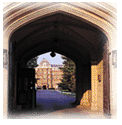
(Photo from http://admissions.vassar.edu/aap/intro_image.gif)
Hunger Action Connects Vassar with the Community
by Katie Aberbach
Megan Allen used to volunteer every Friday at the Lunch Box, Poughkeepsie’s
(only) soup kitchen, in the Family Partnership Center on North Hamilton Street
for the simple reason that it felt good to help others. Now, more than a year
later, as a leader of the Vassar College student organization Hunger Action,
she still makes weekly trips to the Lunch Box, but Allen’s views on volunteering
and hunger in the Hudson Valley have changed. “For a long time, when I
was serving I would say hi to people, but it was mostly just doing whatever
my job was each day,” says Allen, a junior from Knoxville, Tenn. “It’s
kind of overwhelming at first. But now I’ve gotten to know a lot of the
men and women. It’s much more about learning from them. A lot of the actions
that Hunger Action has taken have been based on things that people (at the Lunch
Box) have told us about.”
Over the past year, for example,
students in Hunger Action have organized a food and clothing drive in response
to need at the Lunch Box, and are working on ways to provide additional shelter
and evening meals for people in Poughkeepsie that do not have homes or reliable
food sources. The approximately 60 students in Hunger Action organize a number
of programs at Vassar and in the Hudson Valley community. In addition to Friday
visits to the Lunch Box to prepare and serve food, Hunger Action sponsors community
dinners –free dinners, to which both Vassar students and local community
members are invited—at the Lunch Box once a semester. Once a month, Hunger
Action students cook and prepare lunch at the Beulah Baptist Church. And at
various times throughout the school year, Hunger Action students participate
in Bright Nights (delivering food and clothing to needy people in Poughkeepsie)
and Midnight Runs, which are similar to Bright Nights, but take place in New
York City.
On the Vassar campus, Hunger Action
organizes regular food and clothing drives, as well as educational awareness
programs and speakers. At a recent college Hunger Action “Hunger Banquet,”
students, faculty and administration were invited to a free dinner. To illustrate
some of the social hardships of hunger, however, the diners were randomly assigned
different levels of poverty—and corresponding meals. Those who were the
most impoverished, and therefore suffered the most from hunger, ate only rice
and beans and sat on the floor, while those who were socially and politically
free of the restrictions of hunger ate at tables and were served a nutritious,
multi-course meal.
“We all know that there are
a lot of hungry people in the world,” says Anne Costello, a Vassar student
who attended the Hunger Banquet, “yet we don’t think of it. The
dinner illustrated the overwhelming amount of hungry people in the world in
a manner that made it so clear that you couldn’t ignore it.” After
the dinner, Brian Riddell, the director of Dutchess Outreach, and Jim Stipe
of the organization Bread for the World spoke to the crowd. Those who attended
the Hunger Banquet were encouraged to sign and mail letters to the law-makers,
in support of U.S. farm policy reform.
“At a lot of our events on
campus, we try to have petitions or letters ready to be sent to Congress or
state legislature about different issues of hunger or homelessness,” says
Carolina Fasola, a Vassar senior and a leader of Hunger Action. “We also
travel to conferences (about hunger issues). We just sent a group of Hunger
Action members to Wesleyan to hear Paul Farmer, who is the director of Partners
in Health (a national non-profit organization), about inequalities in health
care. I think it’s great that if you’re a member of Hunger Action,
you can be politically active, or go to lectures, or just go to the soup kitchen
and help out on a personal basis. So you (participate at) whatever level of
involvement that you want.”
Besides the flexibility and range
of Hunger Action’s hands-on events, one of the organization’s greatest
strengths is that it facilitates valuable contact between Vassar students—who,
generally, have had little experience with real issues of hunger, but who are
optimistic about change—and people in the community who have close, personal
knowledge of the topic.
“We can only understand so much by reading about hunger,” Allen
says. “We don’t have to deal with these issues personally and intimately
and so its really, really important to talk to people who do, and to hear their
ideas about addressing the causes and proposing solutions. You both can bring
ideas to the table. That’s one way of solving the problem: bringing those
two (sides) together.”